A Beginner's Guide to Manga Localization
You might think translating manga is just about converting Japanese text into another language. But if you've ever tried it, you know that translation is only the starting point. The real work is localization: adapting everything from sound effects to cultural references so the story feels natural in a new language.
With the global manga market valued at $10.19 billion in 2025 and projected to reach $43.86 billion by 2033 (Grand View Research, 2025), the demand for quality localization has never been higher. Manga now reaches readers in over 100 countries (World Metrics, 2024), yet only a fraction of Japanese titles ever get officially translated. That gap is where localization matters most.
Key Takeaways
- The manga translation market hit $1.72 billion in 2024, growing at 13.8% annually (Growth Market Reports, 2024)
- Sound effects, cultural context, and reading direction are the three biggest localization challenges beyond raw translation
- AI tools now cut localization timelines to one-tenth of traditional methods (MIT Technology Review, 2024), though human review remains essential for published-quality output
- Effective localization balances faithfulness to the original with readability for the target audience
Translation vs. Localization: What's the Difference?
The manga translation market alone is worth $1.72 billion and growing at 13.8% CAGR (Growth Market Reports, 2024). That growth isn't driven by word-for-word translation. It's driven by full localization, the process of adapting a work so it feels natural to readers in a completely different culture.
Translation converts words from one language to another. "こんにちは" becomes "Hello."
Localization goes further. It adapts the entire reading experience:
- Honorifics like "-san" and "-kun": keep them, drop them, or explain them?
- Cultural references that don't exist in the target culture
- Humor and wordplay that only works in Japanese
- Sound effects drawn directly into the artwork
- Reading direction (right-to-left vs. left-to-right)
Here's a useful way to think about it. Translation asks "what does this say?" Localization asks "how should this feel to someone who's never been to Japan?" A good localization makes the reader forget they're reading something originally written in another language. That distinction is what separates a stiff, literal translation from one that actually connects with readers.
What Makes Manga Localization So Challenging?
Japan's domestic manga sales hit a record ¥704.3 billion (roughly $4.7 billion) in 2024, accounting for 44.8% of the country's entire publishing industry (Nippon.com, 2025). Localizing this content for global audiences involves challenges you won't find in regular text translation. Here are the four biggest ones.
1. Sound Effects (SFX)
This is probably the biggest headache in manga localization. Japanese manga uses onomatopoeia everywhere, not just for sounds but for feelings, textures, and states of being. The Japanese language contains roughly 1,200 onomatopoeic expressions, about three times more than English (ANLP, 2024).
For example:
- ドキドキ (doki doki): the sound of a heartbeat (excitement or nervousness)
- シーン (shiin): the "sound" of silence
- ゴゴゴ (gogogo): a menacing rumbling atmosphere (popularized by JoJo's Bizarre Adventure)
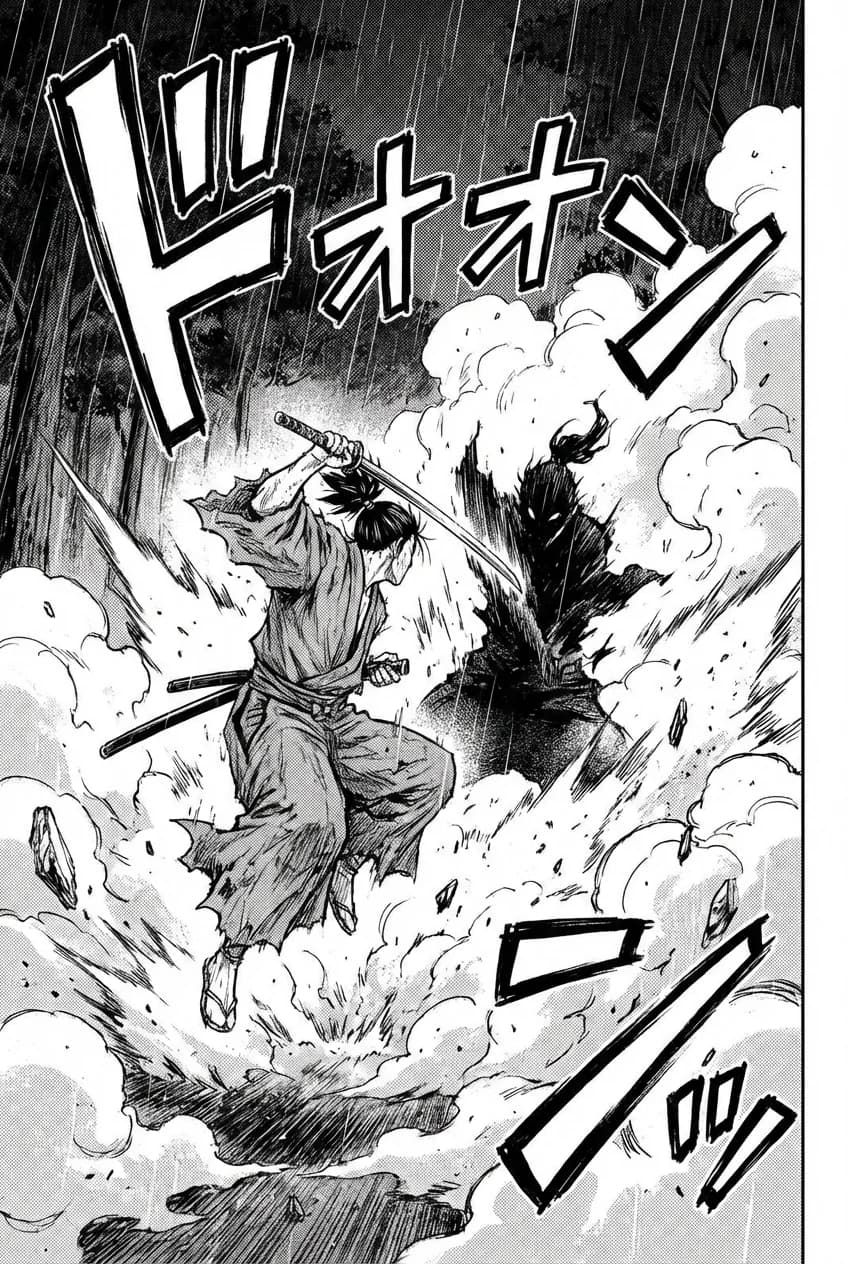
These SFX are often hand-drawn directly into the artwork, making them much harder to replace than dialogue in speech bubbles. So what do localizers actually do? They typically choose from three approaches:
- Leave them in Japanese and add small translations nearby
- Replace them entirely, which requires inpainting the art and adding new text
- Remove them, which loses atmosphere but simplifies the page
In our experience, option 2 produces the best reader experience but it's also the most time-consuming when done manually. AI-powered inpainting has changed this equation significantly. Tools can now detect SFX, remove the original text, reconstruct the artwork underneath, and place translated text on top, all automatically. For a deeper look at how this pipeline works, see our guide on how AI is changing manga translation.
2. Reading Direction
Japanese manga reads right-to-left, the opposite of English and most European languages. This affects everything on the page:
- Page order: The first page is what English readers would consider the "last" page
- Panel flow: Panels are read from right to left, top to bottom
- Speech bubble order: Within a panel, bubbles are read right to left
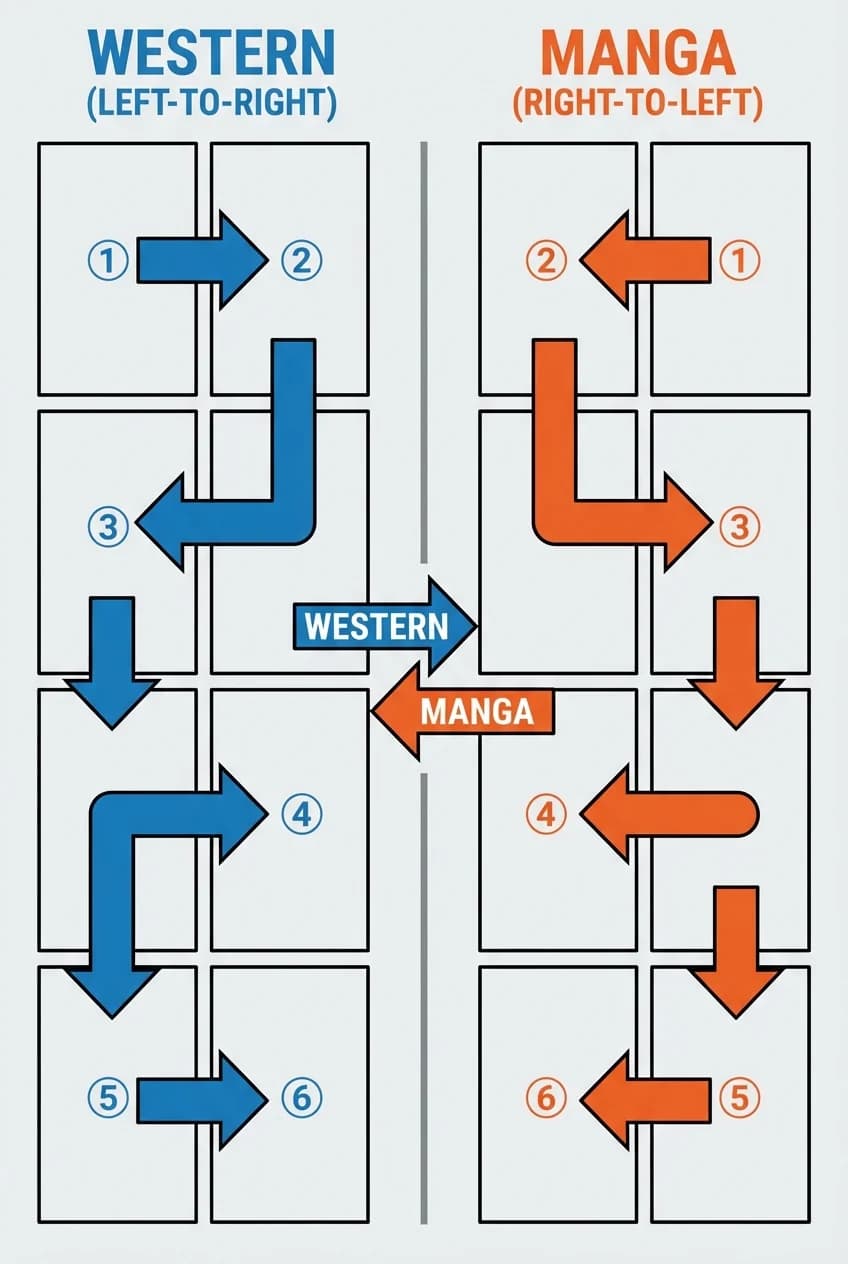
Some publishers "flip" manga pages to read left-to-right, but this creates problems. Characters become left-handed, text on signs is reversed, and the art feels wrong. Most modern localizations keep the original right-to-left format and include a note for new readers. Why? Because manga fans have come to expect it, and flipping distorts the artist's original composition.
3. Cultural Context
Manga is steeped in Japanese culture. A localizer needs to decide how to handle references that don't translate directly:
- Food references: Does "onigiri" stay as "onigiri" or become "rice ball"?
- School systems: Japanese schools have different grade structures, class formats, and cultural events
- Holidays and festivals: Tanabata, Obon, Golden Week. Do you explain them or adapt them?
- Name order: Japanese names are family-name-first, while most Western languages are given-name-first
There's no single right answer here. The best approach depends on your audience. A localization for hardcore manga fans might keep more Japanese terms intact. One aimed at casual readers might adapt more aggressively. Titles like One Piece, translated into 40+ languages (SEAtongue, 2025), show that different publishers handle this differently depending on their market.
4. Text Length and Bubble Space
Japanese is a compact language. A sentence that takes 5 characters in Japanese might need 20 characters in English. But the speech bubble was drawn to fit the Japanese text. Where does the extra text go?
This means localizers often need to:
- Rewrite dialogue to be more concise without losing meaning
- Adjust font size to fit longer text
- Sometimes rearrange text across bubbles
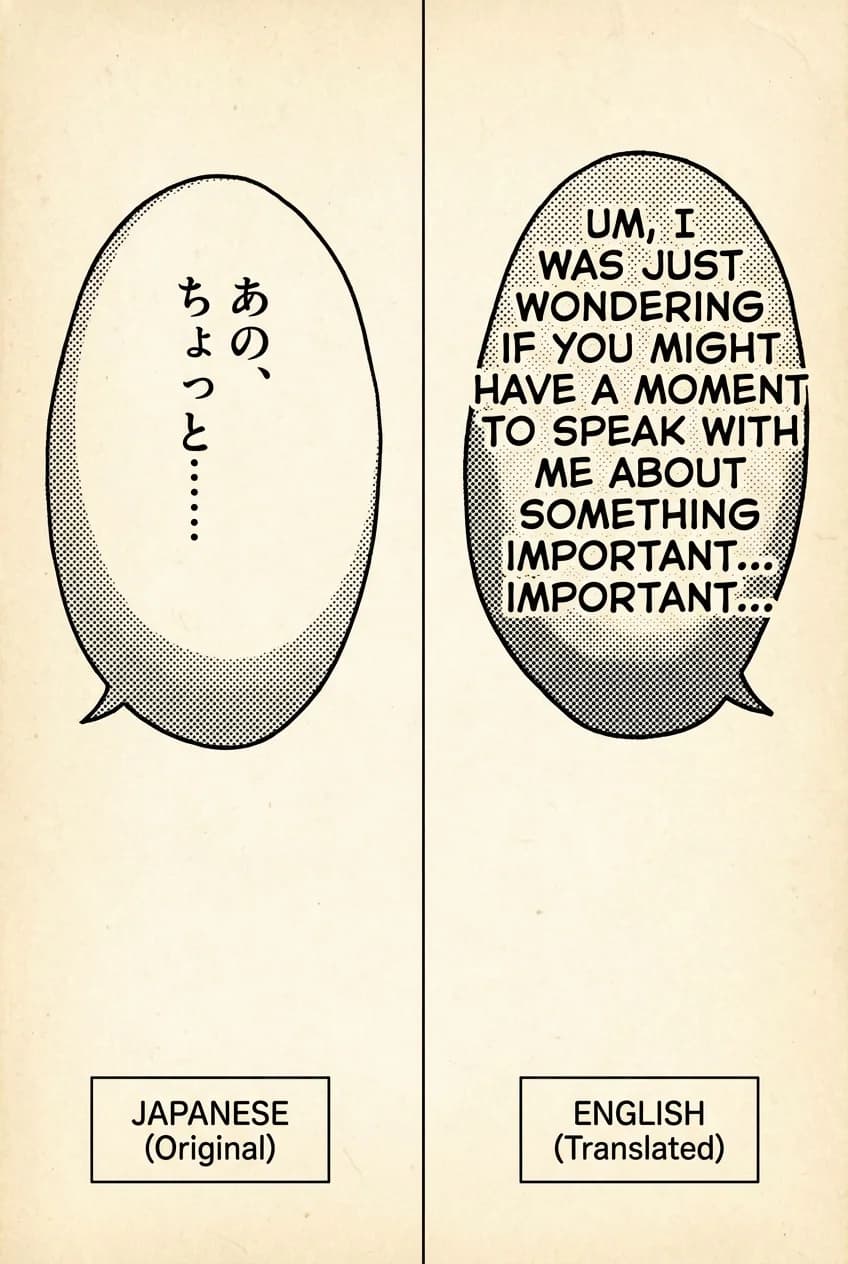
It's a balancing act. You want accuracy, but you can't let text overflow the bubble or shrink the font to unreadable sizes. We've found that the best localizers treat this as a creative constraint rather than a limitation.
How Does AI-Assisted Manga Localization Work?
AI-assisted localization has been shown to reduce translation and publishing timelines to one-tenth of traditional methods (MIT Technology Review, 2024), and automated pipelines already process tens of thousands of pages per month for Japanese publishers (JapanGov, 2023). The technology isn't hypothetical anymore. It's production-ready.
Here's what a typical AI-assisted workflow looks like:
Step 1: Upload and Detection
Upload raw manga pages. The AI detects every text region: speech bubbles, captions, and sound effects, even when they're integrated into the artwork.
Step 2: Translation and Inpainting
The platform translates detected text, removes the originals through AI inpainting, and typesets the translations back into the correct positions. This happens in seconds per page.
Step 3: Human Review
This is the step that separates good localization from mediocre output. A human reviewer adjusts translations that need a creative touch: wordplay, character voice, cultural references. In a 2024 blind study by Lokalise with 615 pairwise comparisons, LLMs achieved "good" ratings in 56-80% of translations (Lokalise, 2024). That's impressive, but it also means 20-44% still need human improvement.
Step 4: Export
Download finished, translated pages ready for reading or distribution.
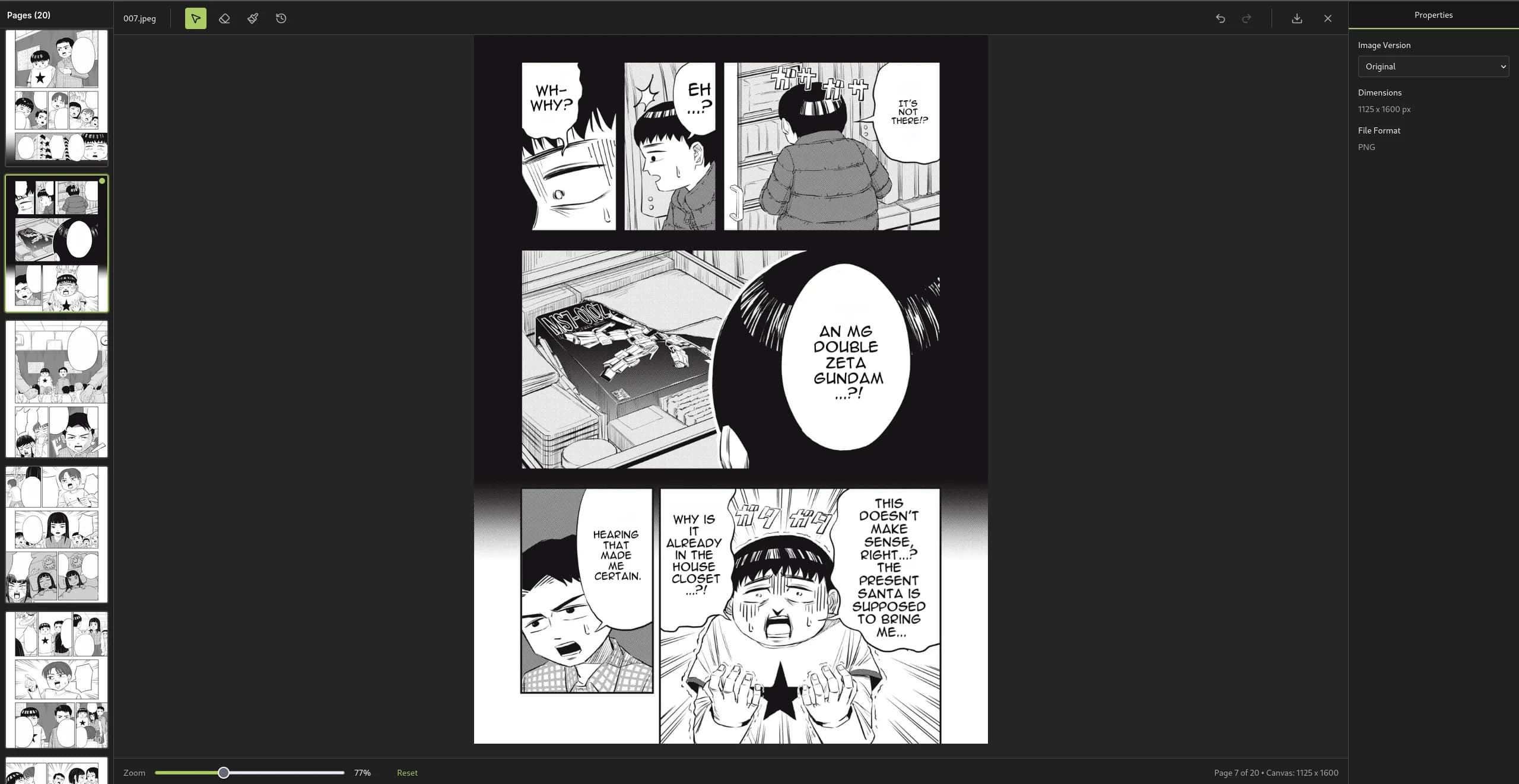
This hybrid approach, AI for speed and humans for nuance, is what the industry is converging on. Current AI translation achieves 70-85% accuracy compared to professional human translators at 95-100% (Weglot, 2025). The gap matters for published work, but for rapid drafts and community translations, the speed advantage is transformative.
Tips for Better Manga Localization
Japan's government wants to triple overseas content sales to JPY 20 trillion ($131.4 billion) by 2033 (Nikkei Asia, 2024). Meeting that goal requires a lot more localization, done well. Whether you're using AI tools or working manually, these five principles consistently lead to better results.
1. Know your audience. Are they manga veterans who expect honorifics and cultural specificity? Or newcomers who need everything to feel familiar? This one decision shapes every other choice you'll make.
2. Consistency matters. Pick a style for handling honorifics, SFX, and cultural terms, then stick with it throughout the entire work. Readers notice when you switch approaches mid-volume.
3. Read the original. Even if you're editing AI-translated output, understanding the original Japanese (or at least the context) helps you catch nuances that automation misses. Short sentences get lost. Jokes fall flat. Tone shifts go unnoticed.
4. Respect the art. Manga is a visual medium first. Your text should complement the artwork, not fight with it. Keep translations concise and let the art do its job.
5. Test with readers. Share your localization with a few people and ask if anything feels off. Fresh eyes catch things you'll miss after hours of editing. This is especially true for cultural adaptations, where what seems obvious to you might confuse someone else.
Whether you're a fan translator, a freelancer, or working at a publishing house, these fundamentals put you ahead of the curve as the market scales up.
Frequently Asked Questions
How long does manga localization take?
Traditional manga localization takes days per chapter when done entirely by hand, covering detection, translation, inpainting, and typesetting. AI-assisted tools like Tenjin have compressed this to minutes per page, and automated pipelines already process tens of thousands of pages monthly for Japanese publishers (JapanGov, 2023). Human review still adds time, but the total turnaround is roughly 90% faster than fully manual workflows.
Can AI fully replace human manga localizers?
Not yet, and probably not soon. AI translation currently achieves 70-85% accuracy compared to human translators at 95-100% (Weglot, 2025). For wordplay, cultural nuance, and character voice, humans remain essential. The practical model is hybrid: AI handles the repetitive technical work while humans focus on creative decisions.
What's the hardest part of localizing manga?
Sound effects (SFX) are widely considered the biggest challenge. Japanese has roughly 1,200 onomatopoeic expressions (ANLP, 2024), many of which describe feelings or atmospheres rather than literal sounds. These are often hand-drawn into the artwork, so replacing them requires both linguistic skill and image editing ability.
How many languages is manga typically translated into?
It varies widely by title. Major series like One Piece are translated into 40+ languages, while Dragon Ball reaches 30+ (SEAtongue, 2025). Most titles receive far fewer translations. Manga is published in over 100 countries, but the majority of translated output concentrates in English, Chinese, Korean, French, and Spanish.
Want to see how each step of the AI pipeline works in detail? Read How AI Is Changing Manga Translation in 2026 for a technical breakdown of detection, inpainting, and typesetting. Just looking to read a series that never got translated? See How to Read Untranslated Manga.