How AI Is Changing Manga Translation in 2026
For decades, manga translation meant dedicated teams spending hours on every chapter, carefully adapting dialogue, sound effects, and cultural context from Japanese into other languages. The results were often excellent. The pace was painfully slow.
That's changing fast. The manga translation market hit $1.72 billion in 2024 and is growing at 13.8% annually (Growth Market Reports, 2024). AI-powered pipelines now process a full chapter in 2-5 minutes — work that takes a human team 3-10 hours. Japan publishes roughly 3,890 new manga titles every year (World Metrics, 2023), and only a small fraction ever get officially translated. AI is closing that gap.
Key Takeaways
- AI translates a manga chapter in 2-5 minutes vs. 3-10 hours for human teams, a 30-60x speedup
- The manga translation market reached $1.72 billion in 2024, growing at 13.8% CAGR (Growth Market Reports, 2024)
- AI achieves 70-85% accuracy compared to human translators at 95-100%, making hybrid workflows the industry standard (Weglot, 2025)
- Vertical Japanese OCR remains a hard problem, with best models at 7.62 CER on clean text (arXiv, 2025)
How Was Manga Translated Before AI?
Traditional manga translation involved five distinct manual steps, each requiring specialized skills. A skilled team could finish a single chapter in a day. An entire volume? That took weeks. With Japan's manga industry generating ¥704.3 billion ($4.7 billion) in domestic sales in 2024 (Nippon.com, 2025), the volume of content far outpaced what human translators could handle.
Here's what the pipeline looked like:
- Text detection: identifying every speech bubble, caption, and sound effect on the page
- OCR (optical character recognition): reading the text within those regions, often in vertical Japanese
- Translation: converting meaning into the target language while preserving tone and context
- Inpainting: removing original text from the artwork without damaging the illustration
- Typesetting: placing translated text back into bubbles with appropriate fonts and sizing
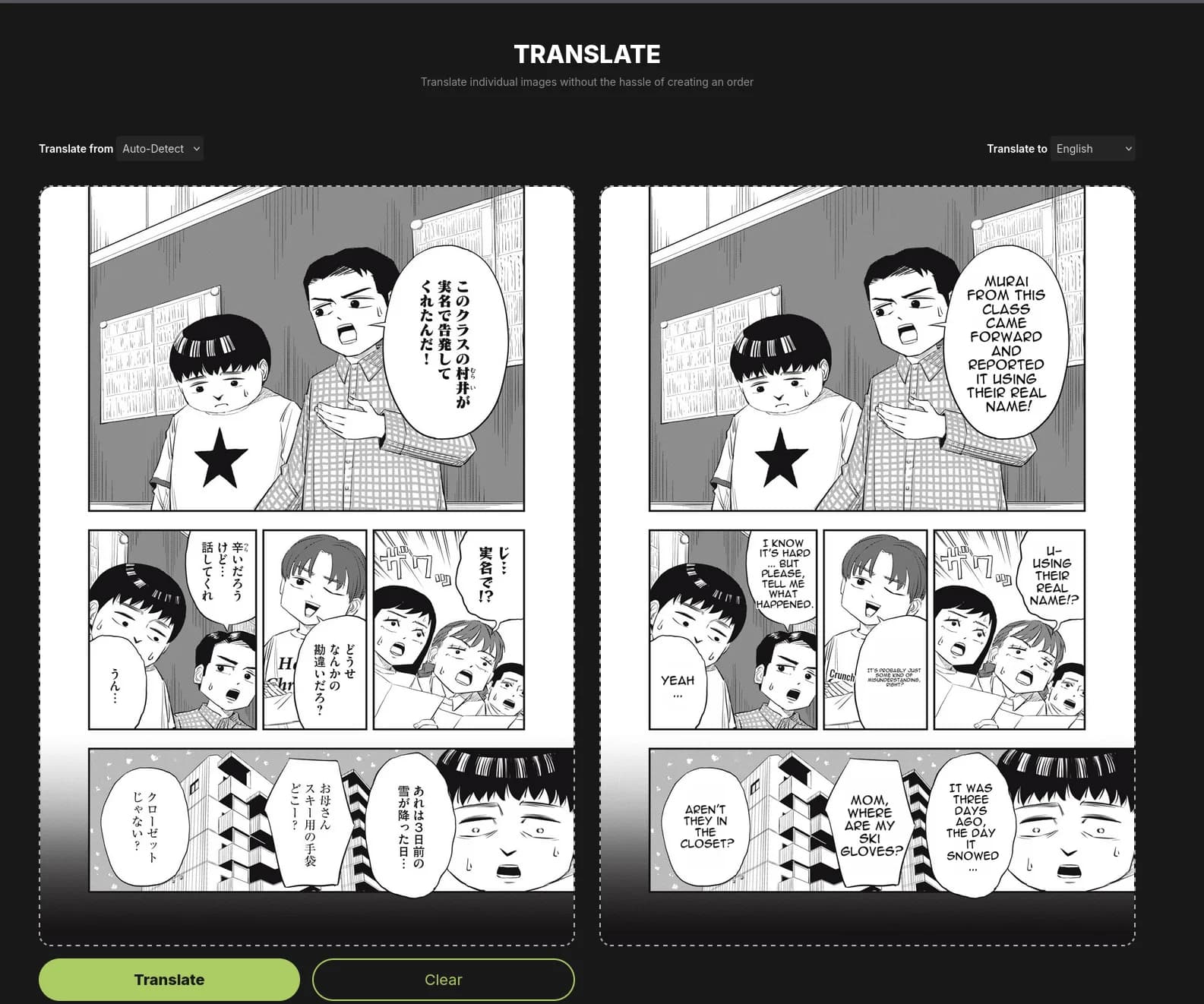
Why was this so slow? Each step depended on the previous one, and each required a different skill set. A translator isn't necessarily a Photoshop expert. A letterer doesn't always read Japanese. Building a team with all five skills, or coordinating between specialists, created bottlenecks that limited output to maybe one chapter per day for a good team.
How Does AI Handle Each Translation Step?
Modern AI manga translation platforms automate the full five-step pipeline. AI-assisted publishing has demonstrated 10x speed improvements over traditional methods (MIT Technology Review, 2024), and automated pipelines already handle tens of thousands of pages per month for Japanese publishers (JapanGov, 2023). Here's how each step works.
Text Detection and OCR: Computer vision models locate text regions and read them. This sounds straightforward, but vertical Japanese manga text is one of the harder OCR problems. A 2025 evaluation of multimodal LLMs found that the best model (Gemma 3 27B) achieved a character error rate (CER) of 7.62 on clean vertical text, while real-world manga documents pushed error rates above 20 (arXiv, 2025). Fine-tuning helps dramatically: one researcher boosted exact-match rates from 9% to 64.4% by training PaddleOCR on manga-specific data (Medium, 2025).
Neural Machine Translation: Large language models translate the extracted text while understanding manga-specific context: character names, honorifics, slang, and the informal tone manga is known for. In a 2024 blind study by Lokalise involving 615 pairwise comparisons and 7 expert reviewers, LLMs achieved "good" quality ratings in 56-80% of translations, with Claude 3.5 Sonnet ranking first and preferred in 78% of cases (Lokalise, 2024). DeepL's next-generation model achieves a 94% match rate on Japanese-to-English text (DeepL, 2024).
AI Inpainting: Generative models fill areas where original text was removed, reconstructing the underlying artwork. The first deep-learning approach specifically designed for manga inpainting combined semantic understanding with appearance synthesis to produce results that outperformed general-purpose methods (ACM Transactions on Graphics, 2021). No smudges, no white patches, no artifacts.
Automatic Typesetting: Translated text gets placed back into the correct bubbles, sized and positioned to fit the layout. This step handles the tricky problem of Japanese-to-English text expansion, where a 5-character Japanese phrase might need 20 characters in English.
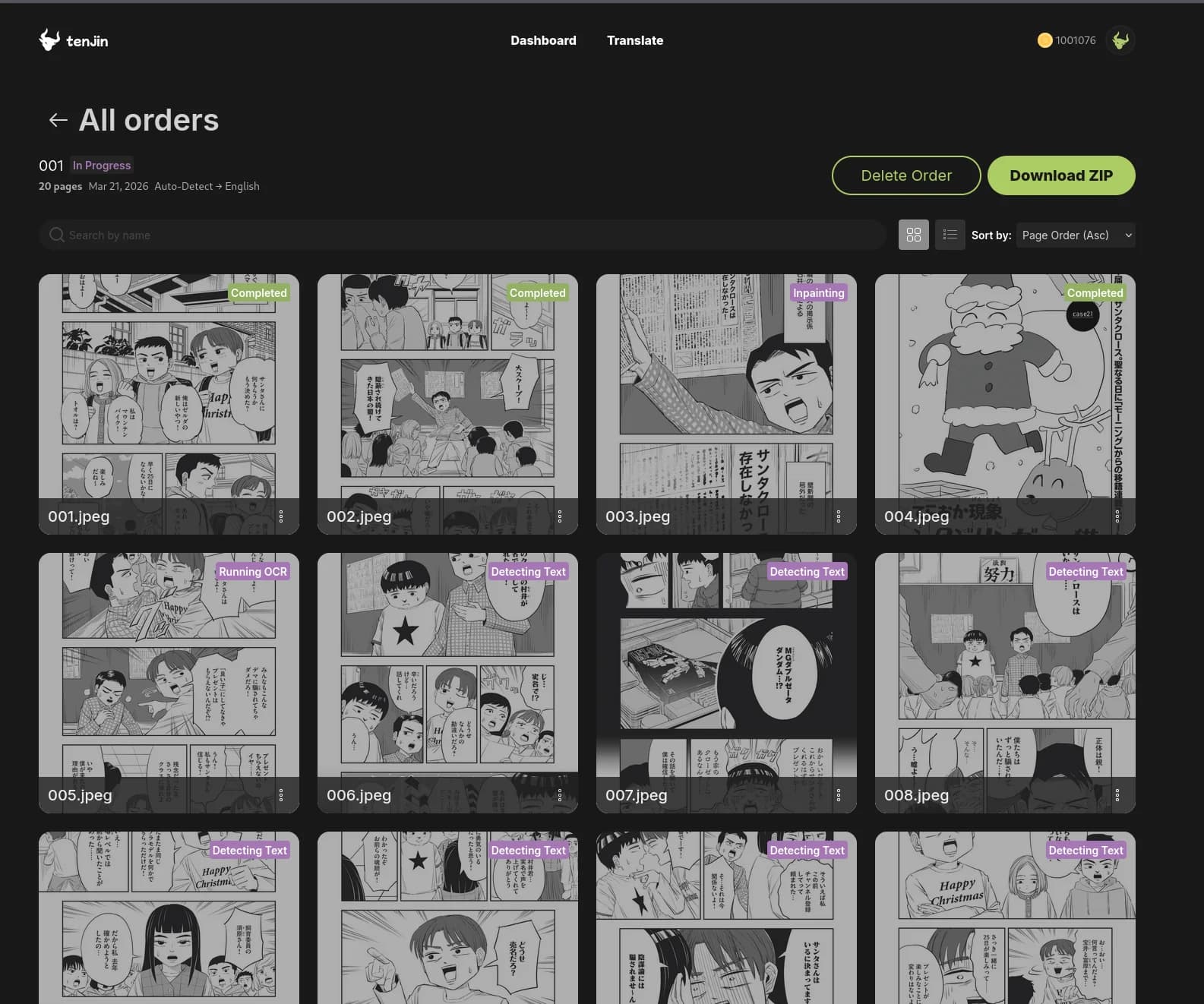
In our experience, the biggest quality gains come from fine-tuning each step on manga-specific data rather than relying on general-purpose models. Generic OCR struggles with stylized fonts. Generic translation misses manga slang. The pipeline is only as strong as its weakest link.
What Languages Can AI Translate Manga Into?
AI-powered translation has dramatically expanded language coverage. Manga is now published in over 100 countries (World Metrics, 2024), but historically, translations concentrated in just a handful of languages. Major series like One Piece reach 40+ languages, while most titles only get English and maybe Chinese or Korean (SEAtongue, 2025).
AI changes the economics completely. Tenjin supports 19 languages, with Japanese, Korean, and Chinese as source languages:
- English, Japanese, Chinese, Korean
- Vietnamese, Thai, Indonesian
- Spanish, French, Portuguese, Italian, German, Dutch
- Turkish, Russian, Belarusian, Ukrainian, Polish, Swedish
A manga that was only available in Japanese can now be readable for millions of people across the world, without needing a separate translator for each language. Does every translation hit native-speaker quality? Not yet. But for readers who'd otherwise have no access at all, it's a massive step forward.
Is AI Translation as Good as Human Translation?
This is the question everyone asks. The honest answer: it depends on what you need. Current AI translation achieves 70-85% accuracy compared to professional human translators at 95-100% (Weglot, 2025). That 15-30% gap matters a lot for some use cases and barely at all for others.
AI translation in 2026 works well for:
- Getting the gist of a manga quickly
- Casual reading where perfect prose isn't the priority
- Bulk translation where speed matters more than literary polish
- Languages with fewer professional manga translators available
Where human translators still win:
- Wordplay and puns that require creative adaptation
- Cultural nuances that need localization beyond literal translation
- Published-quality prose for commercial releases
- Character voice consistency across hundreds of chapters
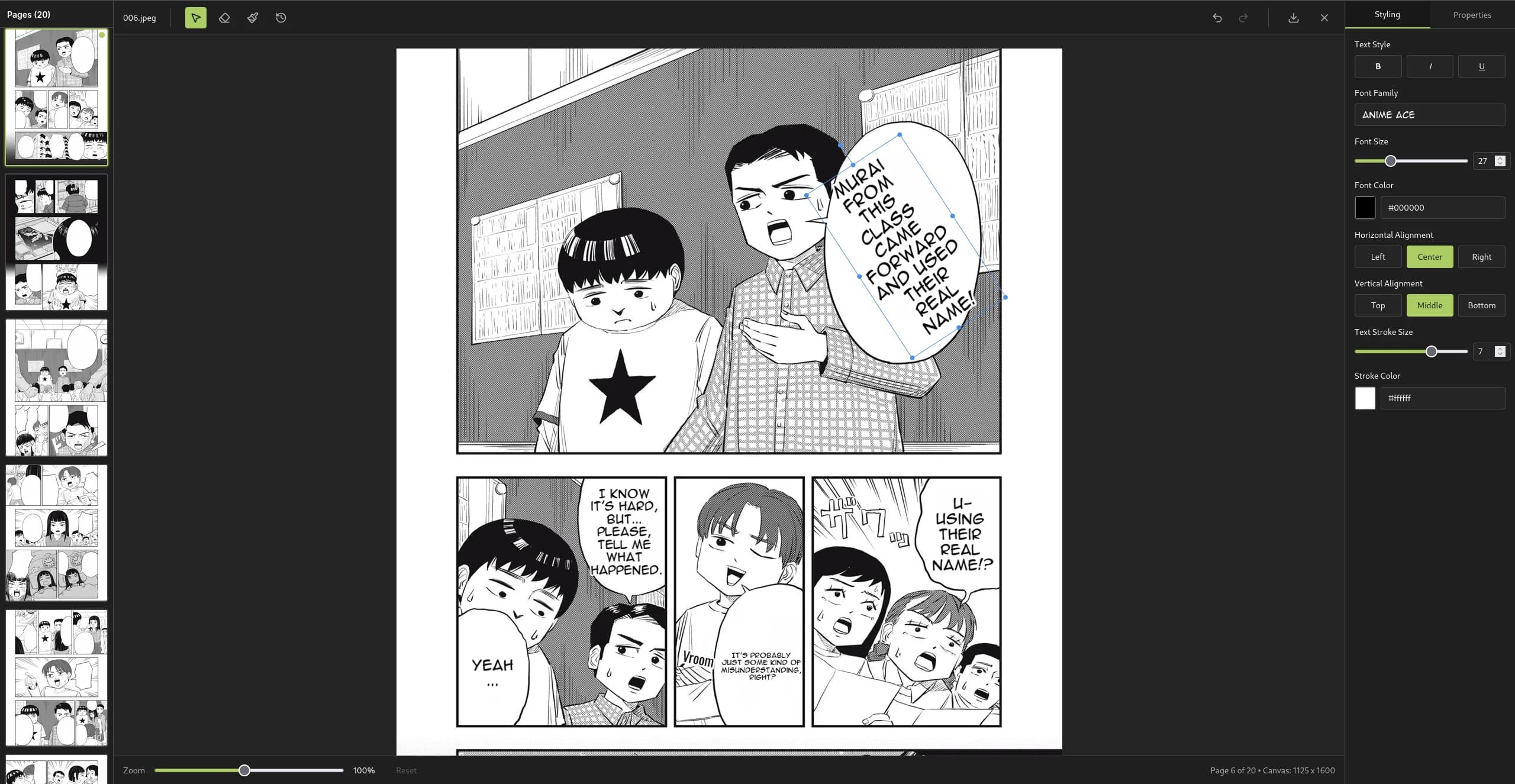
The practical middle ground is using AI for the heavy technical work and having humans review the output. How much review depends on the stakes. A fan community sharing new chapters? Light editing is probably fine. A publisher releasing a physical volume? You want thorough human review on every page.
How Is AI Translation Changing the Manga Community?
Japan's anime industry hit a record $25 billion in 2024, with overseas revenue accounting for 56% of that total (Variety, 2025). Manga demand is growing alongside it. But the translation bottleneck has always limited how much content actually reaches international readers. AI is removing that bottleneck.
The impact shows up in three areas:
- Fan communities can translate new chapters within hours of release instead of days. MangaDex, one of the largest reader platforms, receives roughly 289 million visits per month (Semrush, 2025). That's 289 million monthly visits worth of demand for translated content.
- Independent manga creators can make their work available in multiple languages without hiring translators for each one. The economics shift from "can we afford to translate?" to "which languages should we prioritize first?"
- Readers of less common languages finally have access to titles that were only ever available in English or Chinese. A Thai or Polish reader no longer has to wait years for an official translation, if one ever comes at all.
Japan's government has set an ambitious goal: triple overseas content sales to JPY 20 trillion ($131.4 billion) by 2033 (Nikkei Asia, 2024). AI translation is one of the key enablers for hitting that target. It doesn't replace human translators. It expands what's possible. The manga that would never have been translated at all is now reachable.
Frequently Asked Questions
How fast is AI manga translation compared to manual?
AI processes a full manga chapter (15-25 pages) in roughly 2-5 minutes. A professional human team typically needs 3-10 hours for the same chapter, covering detection, translation, inpainting, and typesetting. That's a 30-60x speedup. Automated pipelines already handle tens of thousands of pages per month for Japanese publishers (JapanGov, 2023).
Which AI models are used for manga translation?
Modern pipelines combine multiple specialized models: computer vision for text detection, fine-tuned OCR for vertical Japanese (best CER: 7.62 on the Gemma 3 27B model per a 2025 arXiv evaluation), large language models for translation (Claude and GPT-4 lead in quality per Lokalise's 2024 study), and generative models for inpainting. Each step uses a different model optimized for that specific task.
Does AI translation work for all manga genres?
It works best for dialogue-heavy genres (slice of life, romance, drama) where most text is in speech bubbles. Action manga with heavy sound effects and stylized text poses more challenges because SFX are drawn into the art. Comedy and wordplay-heavy series need the most human review since puns rarely translate directly across languages.
How many new manga titles does Japan publish each year?
Japan publishes roughly 3,890 new manga titles annually (World Metrics, 2023). Only a small fraction receive official English translation. Over 70% of Japan's manga market is now digital (Nippon.com, 2025), which makes AI translation pipelines easier to integrate since the source material is already in a digital format.
New to manga localization? Read our Beginner's Guide to Manga Localization to understand the challenges beyond translation, from sound effects to cultural adaptation. And if you're a reader rather than a translator, see How to Read Untranslated Manga for a comparison of every option available in 2026.